How Not Having a Time Clock Costs Your Business Dearly
When it comes to running a business, efficiency is king, and all wasted time has a money and opportunity cost. Every minute counts, and even small inefficiencies can snowball into significant losses over time. One often overlooked area where businesses hemorrhage money is in the absence of a robust time tracking system, specifically, a time clock. While some might view it as an unnecessary expense or a sign of mistrust, the evidence overwhelmingly suggests that not having a proper time clock system in place is a hidden drain on your company’s resources, impacting everything from payroll accuracy to overall productivity.
Let’s delve into the tangible and intangible costs associated with neglecting this crucial tool.
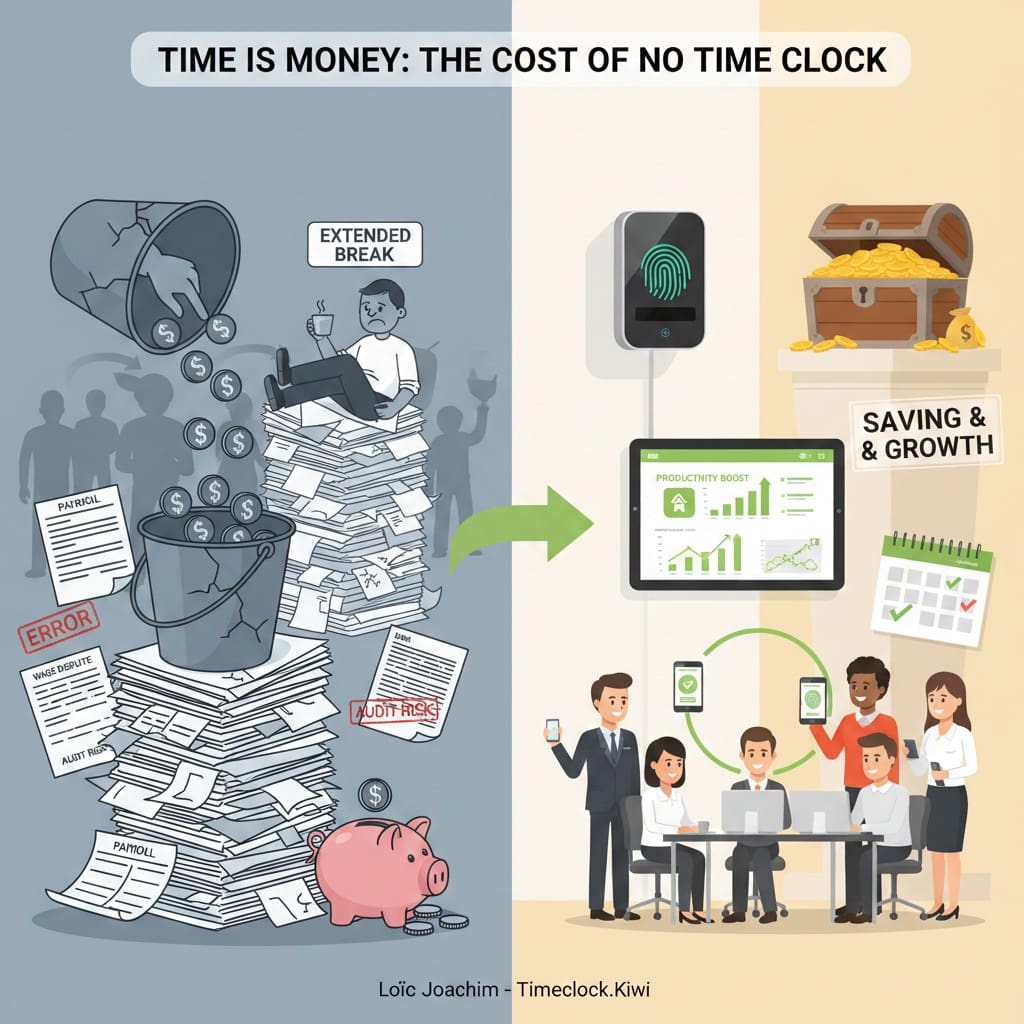
The Leaky Bucket of Manual Time Tracking
Many businesses still rely on manual methods for tracking employee hours, such as spreadsheets, paper sign-in sheets, or even an honor system. While seemingly simple, these methods are ripe with potential for error and abuse, leading to two major financial pitfalls.
The Pervasive Problem of “Time Theft”
This is perhaps the most significant financial drain. Time theft occurs when employees are paid for time they haven’t actually worked, and it manifests in several ways. One key form is Buddy Punching, where a colleague punches in or out for another employee who is late, leaves early, or isn’t even present. Many organizations find that they are affected by this practice, costing them significant amounts annually. Time theft also includes Extended Breaks, where employees take longer lunch breaks or more frequent short breaks than allotted without accurate tracking, and Late Starts/Early Finishes, where employees consistently arrive a few minutes late or leave a few minutes early, which adds up. Even a small amount of unaccounted time per day per employee can cost a company substantial sums annually. While these individual instances might seem minor, the cumulative effect across an entire workforce is significant. Estimates suggest that companies lose a notable percentage of their gross annual payroll to time theft. For a company with a $1 million payroll, that loss could be substantial—money that could be reinvested in growth, employee benefits, or essential equipment.
Inaccurate Payroll and Administrative Burdens
Manual time tracking is inherently prone to human error. Illegible handwriting, miscalculations, or forgotten entries can lead to Overpayments and Underpayments. Employees might be paid for hours they didn’t work, or worse, underpaid, leading to dissatisfaction and potential legal disputes. The lack of automation also results in Increased Administrative Time. Payroll administrators spend significant time deciphering handwritten sheets, correcting errors, and chasing down missing information. This is valuable time that could be spent on more strategic tasks. Companies that adopt automated time and attendance solutions often report a high return on investment (ROI), largely due to reduced administrative costs and improved payroll accuracy.
The Ripple Effect: Beyond Direct Costs
The absence of a time clock doesn’t just hit your bottom line directly; it creates a cascade of other negative consequences that impact your company’s health, affecting productivity, compliance, and budgeting.
Reduced Productivity and Accountability
When employees know their time isn’t being accurately monitored, it can foster a more relaxed attitude towards punctuality and work ethic. This results in a Lack of Structure; without clear start and end times, employees might feel less accountable for their presence and output during work hours. It also causes the Erosion of Fair Play. When some employees are seen getting away with time theft, it can breed resentment among those who are consistently punctual and dedicated. This ultimately leads to decreased morale and a decline in overall team productivity. When employees feel their efforts are not fairly recognized or that others are taking advantage, motivation wanes.
Compliance Risks and Legal Exposure
Labor laws regarding employee hours, overtime, and breaks are complex. Without an accurate, verifiable record of employee time, businesses are vulnerable to Wage and Hour Disputes. If an employee claims they weren’t paid for all hours worked, or for overtime, and you lack concrete evidence, you’re at a significant disadvantage. Regulations mandate accurate record-keeping of employee hours, and non-compliance can lead to severe penalties. Furthermore, government agencies can audit your payroll records at any time, and inaccurate or incomplete records can result in substantial Audits and Fines and legal fees.
Difficulty in Project Costing and Budgeting
For project-based businesses, accurate time tracking is essential for understanding actual project costs, billing clients accurately, and making informed decisions about future bids. This can lead to Undercosting/Overcosting Projects; if you don’t know the true labor hours invested, you might underbid projects and lose money, or overbid and lose competitive advantage. Lastly, this results in Inefficient Resource Allocation. Without data on how much time is spent on different tasks or projects, it’s difficult to identify bottlenecks, optimize workflows, and allocate your workforce effectively.
The Solution: Embracing a Modern Time Clock System
The good news is that these problems are easily solvable with a modern time clock system. Today’s solutions go far beyond simple punch cards:
Biometric Time Clocks use fingerprint or facial recognition systems to eliminate buddy punching entirely.
Mobile Time Tracking Apps allow employees to punch in/out from their smartphones, often with GPS verification, and are ideal for remote or field workers.
Web-Based Solutions are accessible from any computer, providing flexibility and real-time data.
Integrated Payroll means many modern systems seamlessly integrate with payroll software, automating calculations and reducing administrative effort.
A modern punch clock system offers several key benefits:
It Eliminates Time Theft by reducing buddy punching and ensuring employees are paid only for time worked.
It Ensures Payroll Accuracy by automating calculations, which reduces errors and saves administrative time.
It Boosts Accountability and Productivity because it creates clear expectations and fosters a more disciplined work environment.
Crucially, it Ensures Compliance by providing accurate, verifiable records for legal and audit purposes.
Finally, it Provides Valuable Data, offering insights into labor costs, project profitability, and workforce allocation.
Conclusion
Ignoring the need for a time clock system is akin to leaving a leaky faucet dripping in your business—slowly but surely, it’s draining your resources. While the initial investment might seem like an added cost, the long-term savings in reduced time theft, improved payroll accuracy, decreased administrative burden, and mitigated compliance risks far outweigh it.
By embracing a modern time tracking solution, businesses can plug this hidden drain, foster a more accountable workforce, and free up valuable capital to invest in growth and innovation. Don’t let precious time and money slip away; it’s time to put a time clock to work for your company.
Examines how AI automation actually operates in South Africa, from global platforms and consulting partners to freelance builders, and who really controls adoption decisions.
Covers the ANTS platform, private upload services, required documents for used and imported vehicles, processing timelines, and typical causes of file rejection.
Covers on-site service across Pinellas County for AC failures, stuck slide-outs, and appliance issues, plus how mobile inspections and cost factors compare.
Covers efficiency assessments, integration depth, workforce shifts, and pricing ranges that determine whether AI projects help non-tech businesses or get shelved.
An overview of Denver hydration drips, Myers Cocktails, NAD+ infusions, and hangover bags, with notes on altitude context, mobile versus clinic options, and costs.
An A to Z list of hobbies spanning creative, indoor, outdoor, cheap, and unusual options, plus notes on categories and choosing pursuits that fit real adult life.
Covers turn-based formats like Skribbl.io and Gartic Phone alongside simultaneous AI-narrated play in Paint Your Date, and which fits parties, coworkers, or couples.
How a roofing directory narrows local contractors by ZIP code, vetting signals like licensing and reviews, and the split between quotes and emergency repairs.