3 Min Read
People often insist they want backlinks from
We counter these arguments and explain why we think it is BS.
Just search for backlinks on reddit, and you will get a long list of requirements:
We take these mythical bulls by the horns, and deliver a different perspective as to why they may not be as important as others claim them to be.
Everyone will agree that you need backlinks from high-authority websites. At the extremes, educational institutions and news websites have very high authority. What do these websites have to do with your local plumbing business?
Sweet blue f all….
Yet, given the chance to obtain a link from them, anyone will jump on it.
Case Study:
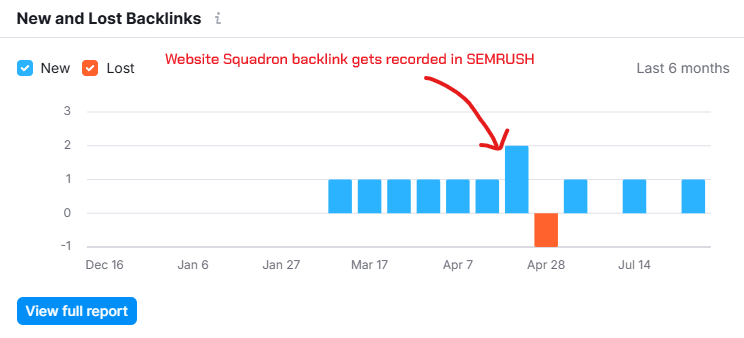
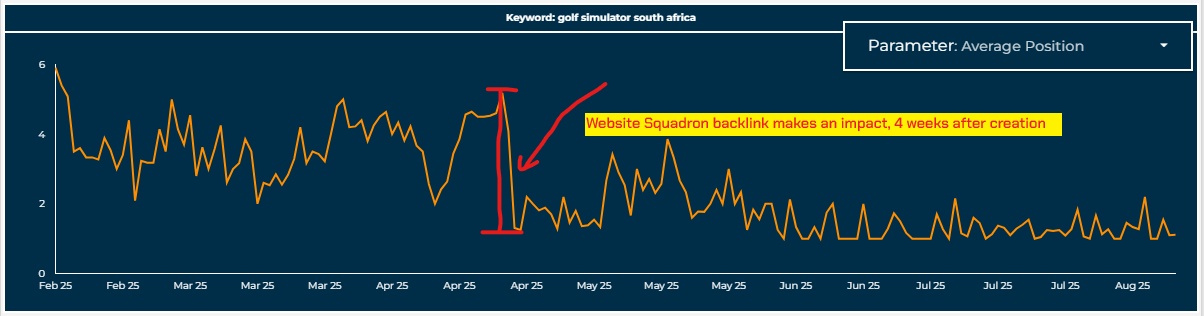
Website Squadron is a website about SEO, we have nothing to do with golf simulators, yet, literally days after our backlinks land, one can see a clear improvement in rankings. Take this example:
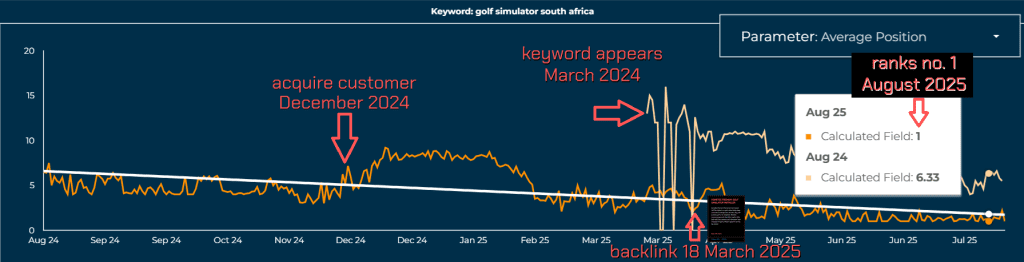
Check out the blog post yourself on how a post using the keyword “golf simulator south africa” increased this golf simulator at home installer’s rankings in South Africa.
The King Of SEO, David Quaid himself, agrees with this strong statement. He did not say it verbatim, but, if you listen to what he said in his recent podcast with Edward Strum, he makes it clear that the local electrician and plumber can link to the local HVAC business.
Ahrefs calls it Domain Rating.
SEMRUSH calls it Authority Score.
Moz calls it Domain Authority.
Google? It does not use any of those. The API leak revealed siteAuthority, Google’s own internal score that measures a domain’s overall trust and credibility. It is not PageRank, and it is not the third-party scores you see in SEO tools. siteAuthority is Google’s way of deciding how much weight a site carries in search, and it explains why some brand-new, link-less pages rank fast.
That is why DA does not mean anything. It is a made-up metric from Moz. DR and Authority Score are no different. This might be useful for comparing sites within a single tool, but it doesn’t signal what Google cares about. A DR 40 backlink does not automatically give your page power. Unless the site’s homepage is linking directly to you, which almost never happens, the number on your SEO dashboard is irrelevant.
What matters is the actual page linking to you, not the site’s overall score. If that page is weak, low-traffic, or buried deep in the site, the backlink will not move the needle, no matter the DA. And if the link lives in a header, footer, or sitemap, Google discounts it because it is everywhere and therefore meaningless.
So the myth is simple: chasing “high DA backlinks” is a waste of time. Google does not see DA. It sees siteAuthority, and it passes value based on context, relevance, quality, and the overall strength of the linking page and domain.
Context is the meaning and surroundings of a link. Search engines examine the anchor text and surrounding words to determine what the linked page is about and how it relates to the linking page.
Relevance, also known as topicality, refers to how well a page aligns with a search query and user intent. It originates from on-page content, such as titles, headings, and body text, as well as what other sites say via anchor text.
Quality reflects trust, authority, and reputation across the site. It blends signals such as trustworthy backlinks, original and useful content, and positive user behavior. High-quality sites are rewarded consistently.
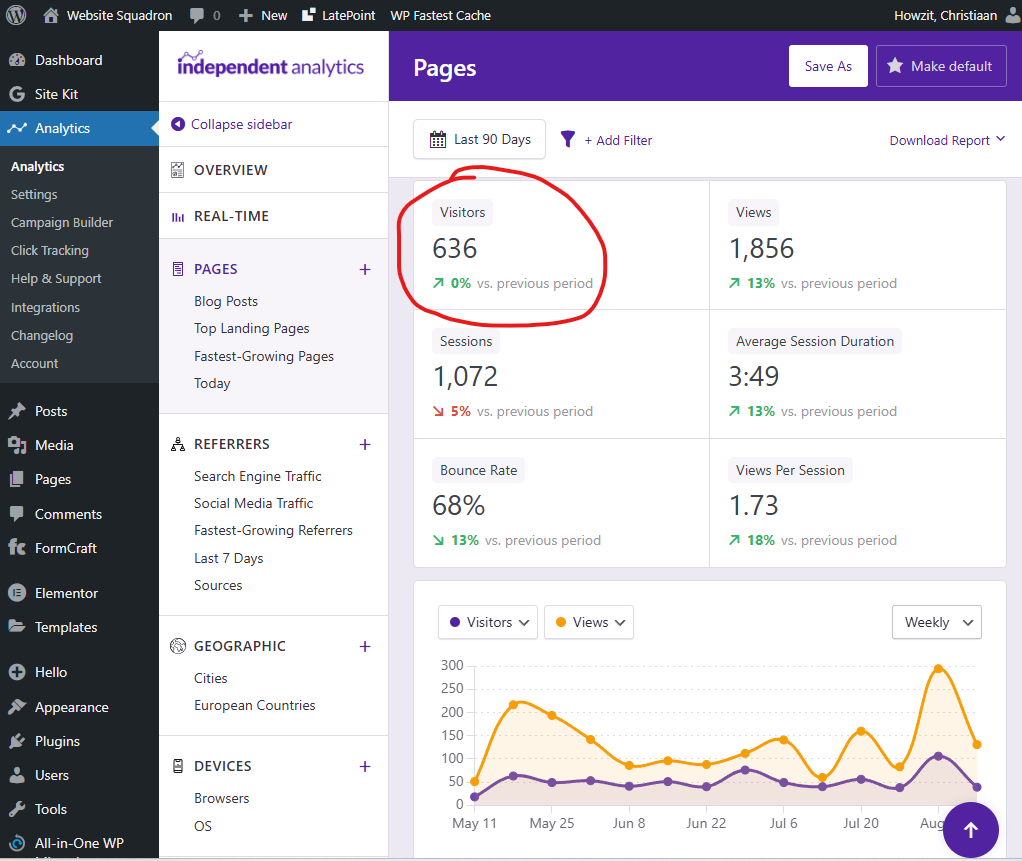
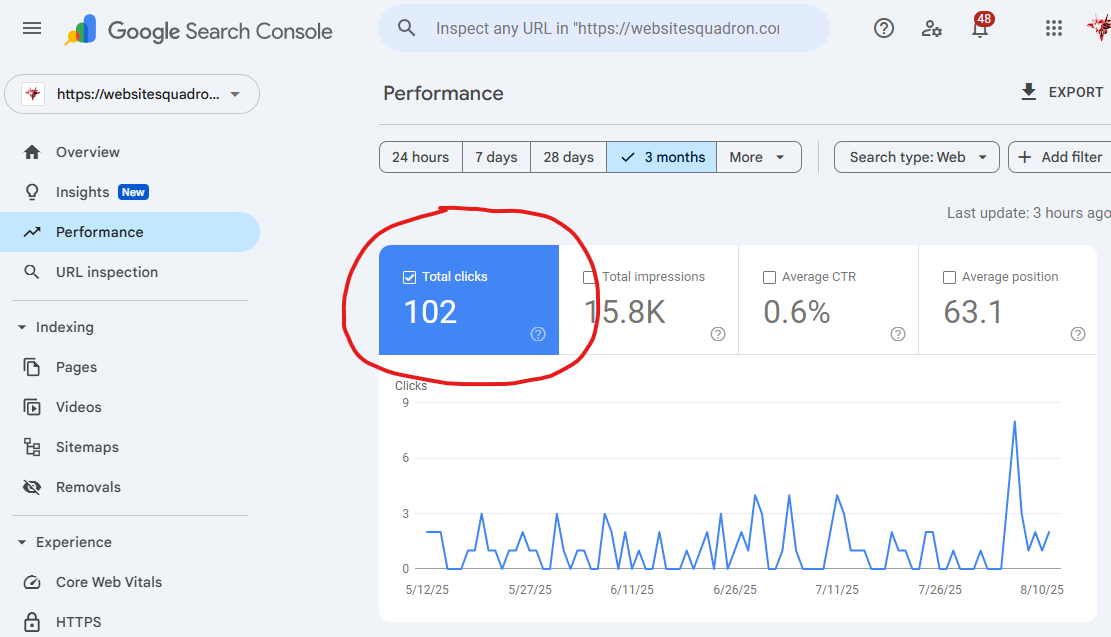
There is a difference between traffic from search and traffic from other sources. The image above shows a like-for-like comparison of Website Squadron’s last 90 days: 636 visitors according to Independent Analytics, but only 102 clicks in Google Search Console.
So when someone says “we need traffic of 300,” that statement is already flawed. They are only looking at Google Search clicks, often through a tool like SEMRUSH. That ignores other sources completely. Search Console also suppresses data for privacy reasons. And what about visitors from social media, other search engines, or even LLMs? Those do not appear in SEMRUSH either.
So what is “traffic”? Raw visitor numbers are not a ranking factor on their own. If they were, anyone could buy traffic or use click farms. What matters is what those visitors do once they arrive. Do they stay to read, click around, or leave right away? Google looks at signals like time on page, bounce rate, and CTR to decide whether a page has real value.
Google has created several easy-to-understand patents to track how users interact with pages. Here are some key examples:
Ranking based on clicks, click-through rate (CTR), and time spent on a page (US Patent 7,716,225, granted 2010).
Ranking based on the Reasonable Surfer Model using user behavior (US Patent 8,117,209 B1, granted 2012).
Ranking based on content engagement signals (US Patent 20,180,011,854 A1, filed 2018).
Ranking based on CTR (US Patent 10,229,166 B1, granted 2019).
Ranking based on query-dependent traffic behavior (US Patent 9,218,397 B1, granted 2015).
None of these say that traffic itself is a ranking factor. Still, organic traffic does matters in practice, but not in the way most make out. A page that receives no visitors does not pass anything, whether it links internally or externally. Anyone with a PBN will confirm this. This is why a little traffic is important, but it must be traffic to the page holding the link.
The overall traffic of the top-level domain is far less relevant than it is made out to be. If the linking page does not get traffic, no amount of clicks to the TLD will have any effect.
So the takeaway is simple. Traffic by itself will not rank you, but pages with some genuine organic visitors are the ones that can pass authority and signals. A traffic-less page, even on a strong domain, is worthless.
Every backlinker will tell you with a smirk on their face: “quality over quantity”.
Then if you ask them to explain what makes a backlink quality, they will immediately jump to DR, traffic, and relevance.
If you have come so far into this page, you will already know that DR and traffic are not the determining factors they are made out to be.
Google will not want anyone to spend hundreds of dollars a month on SEO tools, and will give you all the tools to establish if a website is “quality”. Below is how one can gauge a website’s quality:
Open Google Search and type: site:exact-url-of-linking-page, for example site:example.com/blog/post.
If the page shows up, it is indexed, which means Google sees it as crawlable and potentially valuable.
Then broaden with site:domain.com to check the sitewide index size.
Given the size and what the website is trying to achieve, one can get an idea of whether it is a quality website or not.
Visit the linking page and read the surrounding text. Ask whether the topic aligns with the website’s niche.
For example, if the site is about fitness, check to see if they have several pages about fitness that make sense to the layman.
Load the page, right click the links, and choose Inspect to view the HTML.
Look for the <a> tag and check the rel attribute.
If you see rel="nofollow" or rel="sponsored", it typically does not pass authority. They are doing that on purpose, so you will have to make it clear you do not want nofollow links.
Check where they place the links, preferably around the main body content, not in the footer, sidebar, or comments.
Ensure the anchor text reads naturally, for example, best fitness tips rather than spammy phrases.
Visit the homepage and About page. Look for author bios with credentials, for example Written by Dr. Jane Doe, MD in Fitness.
Search the author’s name on Google to see publications or mentions on other reputable sites.
For trust signals, check for a physical address, a contact form, or a privacy policy.
If the topic touches Your Money or Your Life, confirm that sources are cited, for example, links to studies.
On pages, locate a published or updated date, often near the title or at the bottom.
Fresh content within the last year is a positive sign.
Older than three to five years can indicate stale coverage.
Scan the site’s blog or news section to see the latest post date.
Go to pagespeed.web.dev, enter the linking page URL, and run the test.
Look for performance scores in the green/orange range, typically above 60, on both mobile and desktop.
Consistently low scores can suggest poor technical quality.
Visit Google’s Mobile Friendly Test, input the site URL, and run the test.
Passing without issues, for example, no tiny text or unclickable buttons, indicates a better user experience on mobile.
Load the site and check for https:// in the address bar and a padlock icon.
If it loads with http:// or shows security warnings, consider the site lower quality.
Browse several pages on the site and note the number and behavior of ads. If their ads and popups annoy you, chances are they are annoying other visitors too.
Search the domain with terms like reviews or scam, for example example.com reviews.
Scan for positive mentions from known sites, for example BBB.org, and watch for red flags such as complaints on forums.
If you want to see if a site has some sort of association with your niche already, try site:domain.com plus a keyword from your niche to see if the site ranks for relevant terms.
Review the page for signs of link spam, for example keyword stuffing, hidden links, or excessive outbound links.
If you count more than fifty outbound links on a single page, consider it a risk.
Pages that look like thin directories with little original content are likely low quality.
All these steps can be performed with your browser and Google Search.

For internal use only
Quantity is getting a bad wrap because of spammy backlinks. These are, however, very easy to spot for a human, so will be even easier to spot for a search engine indexer.
There is also a strong argument to be made against disavowing spammy backlinks, as reports suggest that doing so can negatively impact your rankings. Experiences SEOs on reddit will often say: “leave them alone, they do no harm”.
But let me make it very clear, and this is my opinion, spammy backlinks that one has naturally acquired over time, is the normal progression of a website. If there is a sudden spike in spammy backlinks, this is a very clear indication that backlinks were bought.
Above we point out that the DR of a website, has very little bearing on the DR of a web page. So there is a very strong case to be made that web pages, have equal equity, with very few exceptions. So that statement, “quantity over quality”, is most likely true.
Case Study:
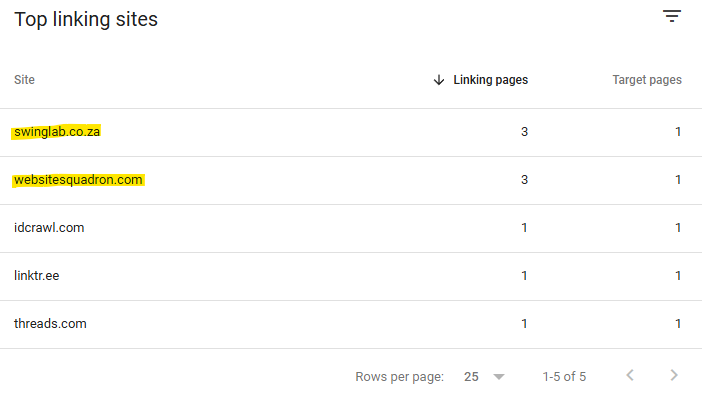
In the golf simulator installer example, according to Google Search Console, they have only 2 backlinks from other websites. Around March / April, a backlink from Website Squadron and Swinglab landed, and around that same time, rankings increased from around 6th to 2nd… to 1st.
EEAT (Experience, Expertise, Authoritativeness, Trustworthiness) comes from Google’s Quality Rater Guidelines, not the algorithm itself. Reviewers use EEAT to judge whether results look credible, but you cannot “add EEAT” to a page and expect it to rank.
Google does not need to see an About Us page, a Meet the Team section, or a company story in order for a backlink to pass value. Backlinks work because of relevance, context, and the authority of the linking page, not because the site displays staff photos or bios. There are thousands of anonymous blogs and link sources that still pass authority, even without transparency pages.
For sensitive niches like finance or health, user trust signals can matter more, but for backlinks in general, Google is looking at the link’s placement, context, and whether the page itself has traffic and authority. Not at whether the site has an “About Us” page.
Truth: A backlink passes weight because of siteAuthority and page relevance, not because the site has EEAT window dressing.
Link velocity is the rate at which a site earns backlinks.
Some believe that there is a strict limit on the number of backlinks a site can gain within a certain time frame, and that exceeding this limit will automatically result in penalties.
Search engines do not use a fixed number to decide whether link growth is good or bad. What matters is context and authenticity. If a site suddenly goes viral due to a news story or launches a widely popular product, it is natural to receive a surge of backlinks, and search engines know this.
When growth looks artificial, such as links coming from irrelevant, low-quality, or spammy sources all at once, this is obviously dodgy. And Google can see that.
There is no hard cap on backlink growth, and search engines prioritize the quality and context of links over their speed of acquisition.
Despite common beliefs that backlinks must come from highly relevant, high‑traffic, high‑Domain‑Rating (DR) sites, we argue that these factors are often overstated.
We argue that even backlinks from seemingly unrelated sources, like high-authority educational or news sites, can significantly boost SEO rankings, regardless of niche alignment or site-wide authority.
Our case study shows a site’s ranking jumping up after receiving just two such backlinks, even without niche relevance or massive traffic.
In short, it’s not about ticking all the supposed “ideal” backlink boxes; meaningful placement, credibility of the linking page, and real impact in search results can matter more than metrics like DR or niche match.
What some of our customers had to say:
EXCELLENT Based on 38 reviews
 Posted on Google
 Denis Cojocaru13/02/2026Cea mai bună agenție SEO din București, Sector 6. Staful știe ce face, am avut rezultate foarte bune cu ei!Posted on Google
 Georg Wittb25/01/2026A friend recommended me this seo agency in Bucharest. After working with them I can say, they are very professional & they really understand how it improve your digital presence.Posted on Google
 Carmine D'Onofrio25/01/2026I was pleasantly surprized to find the best SEO agency în Romania, right here în Sector 6 of all places. I highly recommend them.Posted on Google
 Mircea Popescu23/01/2026Locuiesc in București, sector 6 și am fost surprins să aflu că există o agenție SEO fix lângă casă.Posted on Google
 dan albu10/01/2026Cea mai buna agentie SEO cu care am colaborat! Recomand cu incredere!!Posted on Google
 Mike Meyerson01/11/2025It's refreshing to work with an agency that truly understands the latest SEO guidelines and how to implement them effectively with WordPress sites. Their passion for helping clients succeed is evident. We saw impressive results much faster than we had expected. After some mediocre attempts with other providers, we're glad to have found them. Highly recommended!Posted on Google
 Enea Ionut21/10/2025Mii de multumiri Christiaan!!! Recomand cu incredere Website Squadron! Am colaborat pentru a ne imbunatati vizibilitatea online, iar rezultatele sunt clare. Strategia lor integrata de SEO, implementarea eficienta a campaniilor de Google Ads si optimizrea platformei WordPress au dus la o crestere vizibila a pozitiei noastre in clasamentul Google. Comunicarea fost excelenta, iar expertiza lor in domeniu este de necontestat. Un partener de incredere pentru crestere organica si platita.Posted on Google
 Fiona Kertalli09/10/2025We found the best seo agency in Bucharest. It is a pleasure to work with these guys.Posted on Google
 Buck south Landscaping30/09/2025"We get incredible results from this seo agency, sitiated in Romania of all places."Posted on Google
 Agustin Sanchez30/09/2025⭐️⭐️⭐️⭐️⭐️ “Website Squadron did an outstanding job building my website! They were professional, responsive, and really took the time to understand my business. The design looks clean, modern, and easy to use. I’ve already noticed more customers finding me online thanks to their work. Highly recommend Website Squadron for anyone looking to grow their business with a strong online presence!”
Anchor text.
Clicks on the anchor texts.
Yes.
Citations and Sponsored paid links are allowed.
No, over-optimizing anchor text is a common SEO myth. While having some backlinks with exact match anchor text (for example, “buy running shoes”) can signal relevance, using it excessively can trigger search engine filters such as Google’s Penguin algorithm.
Search engines look for natural link profiles, which means a healthy mix of branded anchors, partial match anchors, generic text (like “click here”), and even naked URLs.
A backlink profile that is too heavily weighted toward exact matches may be flagged as manipulative and could harm rankings rather than improve them.
Do not, however, worry about it too much. We have seen sites with 50 exact match anchor texts, and they rank first just fine.
This page was last updated on 31 August 2025 by u/WebsiteCatalyst.
If you have any questions, try our FAQ.
 I need an SEO wingman